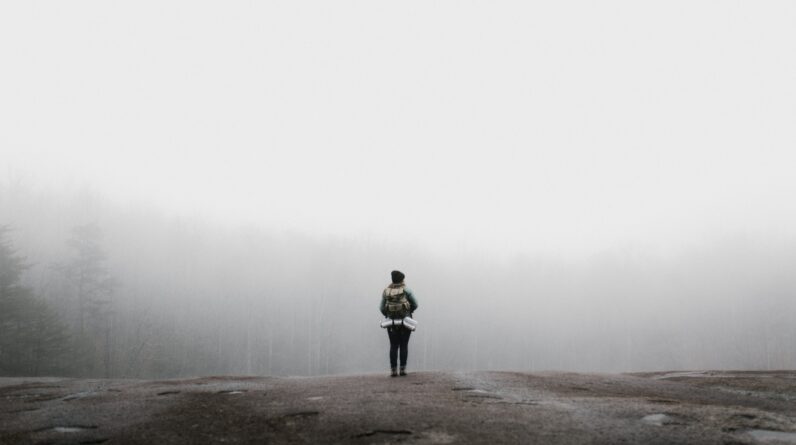
Alex Theissen was on the verge of panic because he was six hours from the trailhead, two hours past his turn-around time, and storms were moving in from the valley. A hike in the White Mountains became a nightmare, and he might have to spend the night outside with only some hard cheese and a foil survival blanket in freezing weather.
If you’ve ever been lost while biking, stranded on a windy shore during a storm, or stuck on a ridge with bad weather coming, you know the feeling of fear that comes with it. What happens next is frequently the crucial point at which survival or complete tragedy occurs. The acronym is S.T.O.P. (Stop, Think, Observer and Plan) was the first step in Theissen’s survival.
Theissen sat down, took stock of the situation, and took action that most likely saved his life rather than succumbing to an all-too-human panic reaction. It’s a lesson that applies to all hikers, hunters, canoeists, and anyone who finds themselves exposed and unprepared in dropping or already chilly weather. What follows is a briefing on what went through his thoughts.
1. Warmth and Shelter
Exposure can kill in frigid weather before anything else gets a chance. Theissen’s situation made staying above the timberline impossible; as a result, his top aim was to descend below the treeline. He would then need to find or make a shelter, followed by creating warmth (if possible).
While describing how to build a shelter or a fire in detail is beyond the scope of this article, shelter can be found in tree wells, snow caves, and hollows in river banks. In winter, tinder may be scarce but dry evergreen needles, bark with pitch, and dry leaves and grass under trees and rocks can still be found.
Theissen discovered a hole in a root that he used as a shelter and to get tinder. He closed it with snow and used evergreen boughs to insulate it from the ground. He was able to maintain a fire that offered some level of comfort and focused heat.
2. Locating a Route
The approaching whiteout made it impossible for Theissen to navigate his way back to the trailhead. It was difficult enough to descend to the treeline. However, he was not lost, and he needed to maintain that fact.
As route finding depends on vision, becoming lost is more likely when traveling at night, during a whiteout, or through densely forested areas. In these circumstances, it’s especially crucial to consider, observe, and plan—as well as to acknowledge that it’s not always advisable to take action. Staying put is frequently preferable to stumbling around in uncharted territory and running the danger of greater damage and disorientation.
Theissen planned to mark his way back to the starting point and only go as far as needed for protection to find the trailhead when visibility improved.
3. Gaining Recognition
If everything went well, Theissen would spend the night in his temporary abode and leave the next morning. Naturally, this assumes that he wasn’t lost. If he were, setting up the right conditions for discovery would come first. Experts agree that the three essential conditions will boost the odds of a rescue crew detecting a missing hiker…
Signals, markers, and smudge flames increase visibility.
Positioning: at the treeline, on broad riverbanks, and on ridgelines
Mobility (or lack thereof) – finding stationary targets is simpler
If Theissen got lost, he would try to make himself more visible by doing things like printing a signal in the snow, using his foil blanket, or making a smudge fire. He would also stay close to the ridgeline when the weather allowed it.
4. Water intake
It scarcely needs to be stated that the ice and snow you are surrounded by are a feasible source of hydration if you have fuel and a way to light it. If it’s not available, there are other options to consider. Depending on how cold it is, flowing water can often be found in river bends and in the bottoms of creeks under the snow cover. Swamps and ponds will remain ice-free in sections because of animals and birds. Solar radiation in the alpine can be enough to melt ice on dark rock faces.
5. Diet
Any self-rescue plan must pay close attention to nutrition because it can be more difficult. Although it is possible to go for weeks without eating, hunger is incapacitating and reduces the body’s tolerance to cold and capacity to cope. When the weather is cold, the body needs additional calories to maintain its warmth.
There is a solid reason why frozen landscapes are commonly described in survival literature as arid; there isn’t much to eat or anything living. As trite as it may sound to say it, leaving sooner rather than later is a wise move. All efforts should focus on placing oneself to be found or logically and methodically finding a route out once the situation has stabilized. Winter is the season when one dies of malnutrition before summer.
In the end, the Theissen’s storm subsided, and by three in the morning, the White’s were illuminated by a magnificent moon. Theissen could return to the ridge line and locate the designated descent by sunrise because there was ample light. He had foolishly chosen to disregard his turn-around time the day before. He made a wrong decision and got lost during his hike, but he made good choices after that, and by the next afternoon, he got back to his car feeling tired, hungry, and embarrassed, but grateful to be alive.